10 Lessons – Part 5 – Building Condition

10 Lessons - Part 5 - Building Condition


Hi, and welcome back to part 5 in our 10 part article series on the 10 things I have learnt about property development, while navigating construction and property investing in South Africa..


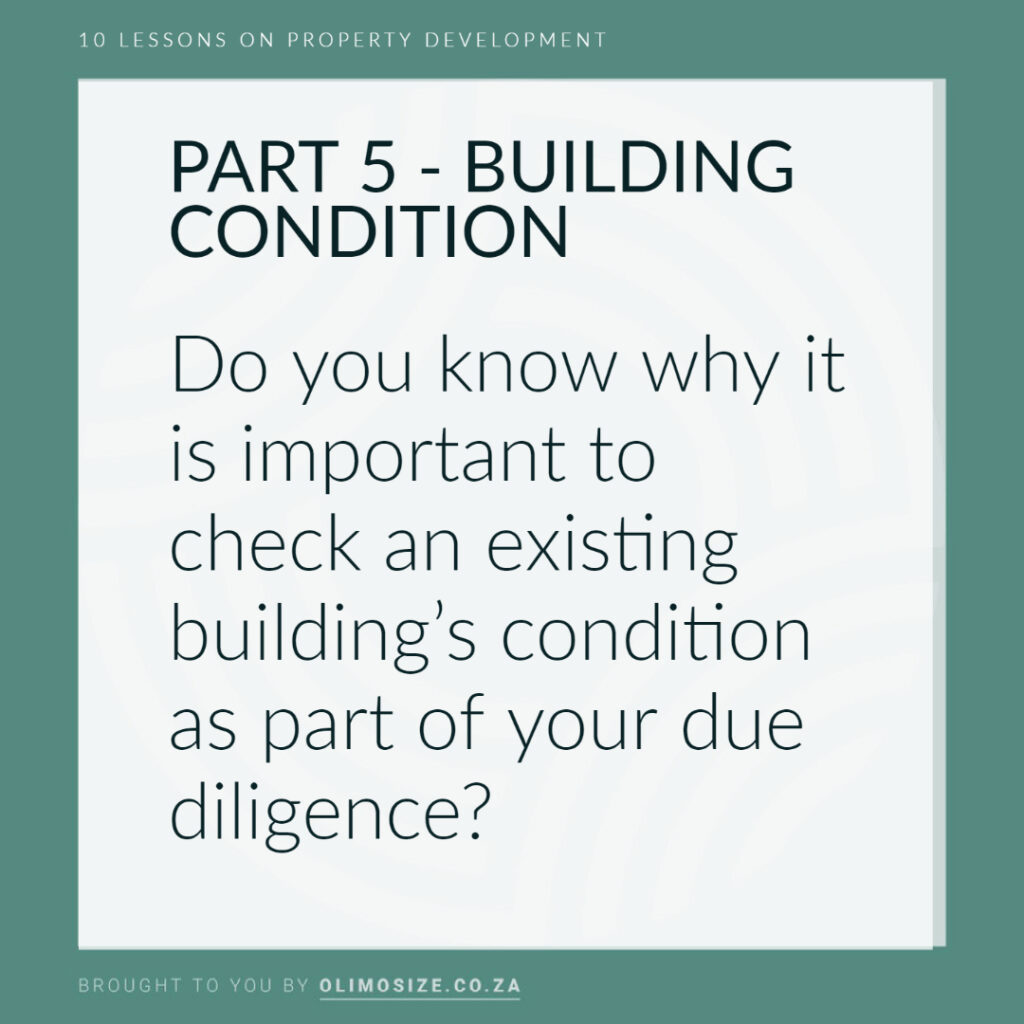
In this lesson I want to touch on a few items that relate to properties already developed with buildings, and why it is important to know what the overall condition of the building is, for example if there are any hidden or unknown issues, such as damp or rotting roof trusses on the building and what you can do about it..


No matter the property type, residential, commercial office block, retail mall, it is recommended to get a building condition inspection done. A building condition Assessment will inform of any potential problems and costs, that might be encountered down the line. Buildings of a certain value may, in addition to the normal requirements, have a Building Condition Assessment as a requirement for financing the purchase. .


A building condition assessment will check the exterior site and grounds for signs of maintenance; the structure for major cracks and the source of these; the building exterior for any structural and finishing issues; the building interior for any finishing issues; the mechanical systems, such as plumbing and air-conditioning, for the current condition and expected time to replace these at the end of their useful life span; and finally for regulatory compliance to check the safety, compliance and functionality of the systems to ensure that the building has been built to regulation code.
OlimoV5-31


Let me explain why this is so important. Unknown or undeclared defects and problems will soon enough cost money to repair and is not something a new property owner wants to land up with, especially if it is a big problem like rising damp. But, similarly, there may be features and fixtures on a property that increase its equity value. With a formal building condition assessment, these costs and features are clearly identified and listed, which makes a good case for obtaining a lower purchase price on the property due to the amount of repair works required, or as support for financing due to the higher equity that can be realized.


It should be noted here that with the release of the Property Practitioners Act no 22 of 2019, persons selling a property are legally required to provide a signed disclosure document listing all of the defect items that they are aware of. This is to ensure that the buyer is not left with a surprise discovery and bill to replace something major just after they took possession. However, people only know what they know, and if the owner doesn't know of a defect, they will not be able to disclose it, which is why it is recommended that you get a professional to check and provide a formal building condition report..
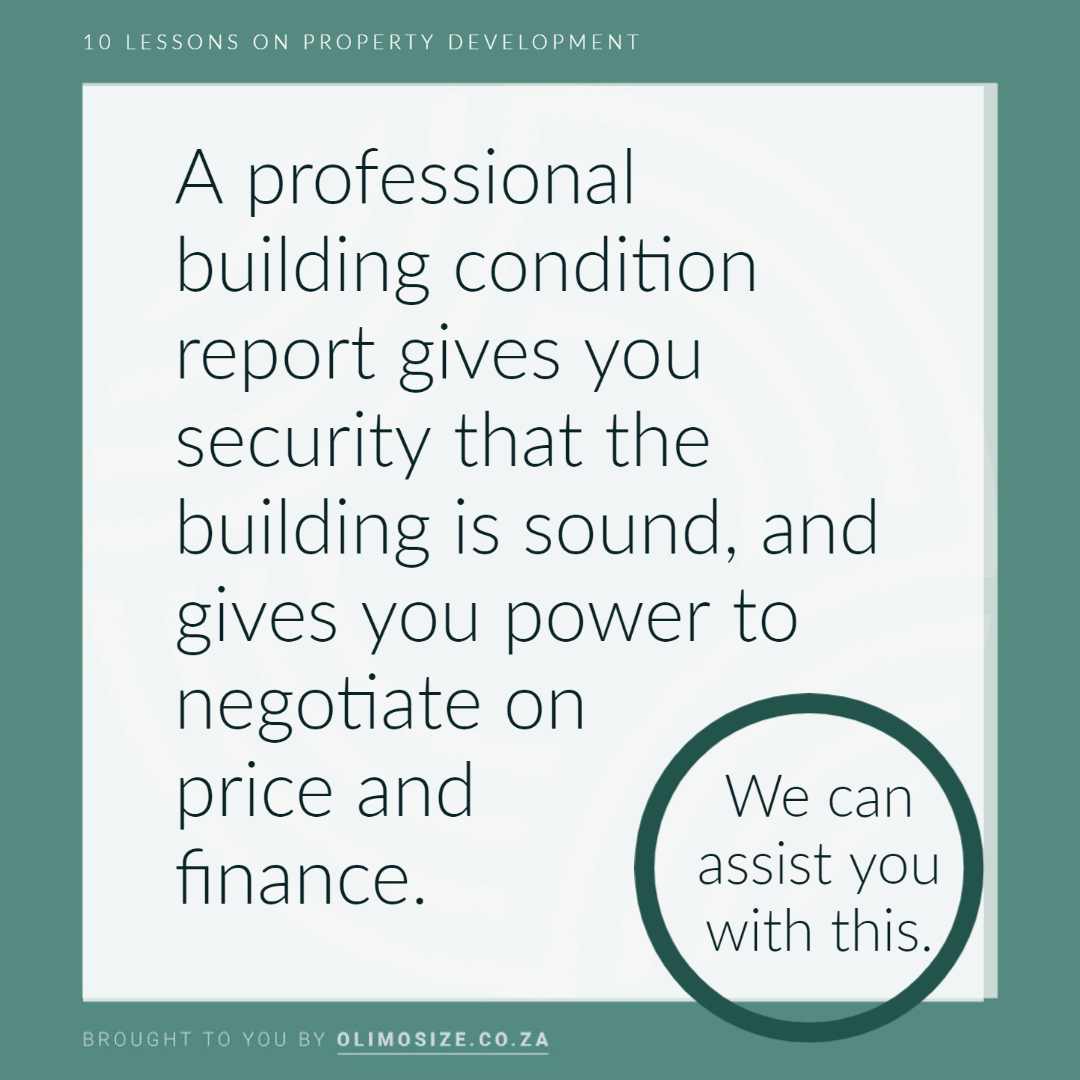

Again, I cannot stress this point enough, make sure that you find out everything about the property and land before making a final commitment, it usually saves you a lot of money in the long run.
OlimoV5-6 (1)


There you have it, part 5 of the 10 lessons I have learnt about developing property through being a project manager. I hope that you have gained some insight from this article that will help you to make more informed decisions on your next building project.


Be sure and keep an eye out for my next articles on the remaining lessons, and leave a comment with any questions or topics you would most like to hear about next. You can also sign up to our mailing list and receive our articles direct in your inbox so you never have to miss an issue.
Sign Up Here

10 Lessons – Part 4 – Project Teams

10 Lessons - Part 4 - Project Teams


Hi, and welcome back to part 4 in our 10 part article series on the 10 things I have learnt about property development, while navigating construction and property investing in South Africa.


Let's jump right in to our next topic, Project teams.


In this weeks' article we will be talking about the team of professionals that are required to allow a property development project to get out of the ground. Having your power team together when putting together a property deal is a hot topic in investor circles, but the team usually spoken about, only focus on the legality and financial aspects of the deal itself. Once you are ready to move ahead with your project, there is another team that is required in order to make the rest of a development project work properly. Most of the team members mentioned below are required from the due diligence stage of your project and I'm going to give a breakdown of some of the professionals who will form a crucial part of that team:


A Project Manager


(that's us) We're the people who are going to help to navigate the murky waters of bringing the development into reality. Developing a property can be a time-consuming and technically detailed process, so having assistance from a professional who has the right knowledge and understanding and can assist in effectively managing the project, to bring it legally, timeously and within budget to completion, is crucial. It would be my function to ensure that the correct professional team is in place and performing their functions; that the building plans are submitted, approved and used correctly; that the appointed contractor is working to code and within budget; and to ensure that at the end of the process a legally built development is handed over for occupation. To note just some of the issues that are managed by the project manager..


TIP: Use a Project Manager who has experience with the types of developments that you are trying to undertake.
OlimoV4-31


They will assist you in understanding the land use rights and current zoning information for the property in question. Remember, I mentioned them in my previous article on zoning. They also assist with preparing and submitting any applications that may be required in terms of land use. If any other studies are required that relate to the land-use, these services will usually be included under this professional, but may be undertaken by other professionals. Such studies could for example be, environmental impact assessments, geotechnical investigations and land surveying, to mention only a few.


Town Planner


Architect


TIP: Select a Town Planner who operates within the area of your development, as they have intimate knowledge of the scheme for the area.


I'm sure all of you know this one. The architect will help you to design the building structures and site layout for your development. What I mean by this tip, is that different types of buildings require different components in the design. Commercial and residential buildings are different in how they work, and this is reflected in the design drawings. Some architects will also only provide a concept design, that would be passed by council, however, they do not provide any further design input, such as construction layouts, tiling layouts, door and window schedules or product specifications to achieve the look proposed. To source all of the different products yourself takes up a lot of time and energy.


Quantity Surveyor


TIP: Make sure you appoint a professionally registered architect and one with experience with your type of development.


A quantity surveyor is the person on your team that determines exactly how much your building work is going to cost. They understand building methodology and therefore understand the different activities and products that need to be used to build, for example, for building a foundation, they will understand that you need cement, sand, stone, bricks, shuttering and rebar, etc., and they understand how to calculate the quantity that is required for the work. The quantity surveyor is better to use than a builder when costing a project as they are independent and are able to provide objective, market related pricing, where a builder / contractor may often take the highest priced option or omit items, which could impact the project budget later on.


TIP: It is better to use a quantity surveyor to measure and cost your project than a builder.
OlimoV4-41


There you have it, part 4 of the 10 lessons I have learnt about developing property through being a project manager. I hope that you have gained some insight from this article that will help you to make more informed decisions on your next building project.


Be sure and keep an eye out for my next articles on the remaining lessons, and leave a comment with any questions or topics you would most like to hear about next. You can also sign up to our mailing list and receive our articles direct in your inbox so you never have to miss an issue.
Sign Up Here

10 Lessons – Part 3 – Vacant Land

10 Lessons - Part 3 - Vacant Land


Hi, and welcome back to part 3 in our 10 part article series on the 10 things I have learnt about property development, while navigating construction and property investing in South Africa.


Let's jump right in to our next topic, Vacant Land.


In this weeks' article we will be talking about buying a farm or piece of vacant land, and all of the things you need to get done before your building dreams can take flight.


Let me give you an example.


Here's the scenario, you have found a great piece of land just outside of town in a mostly agricultural area which has recently started sprouting large sectional title complexes. You want part of the action to build your own townhouse complex and so you buy the land.


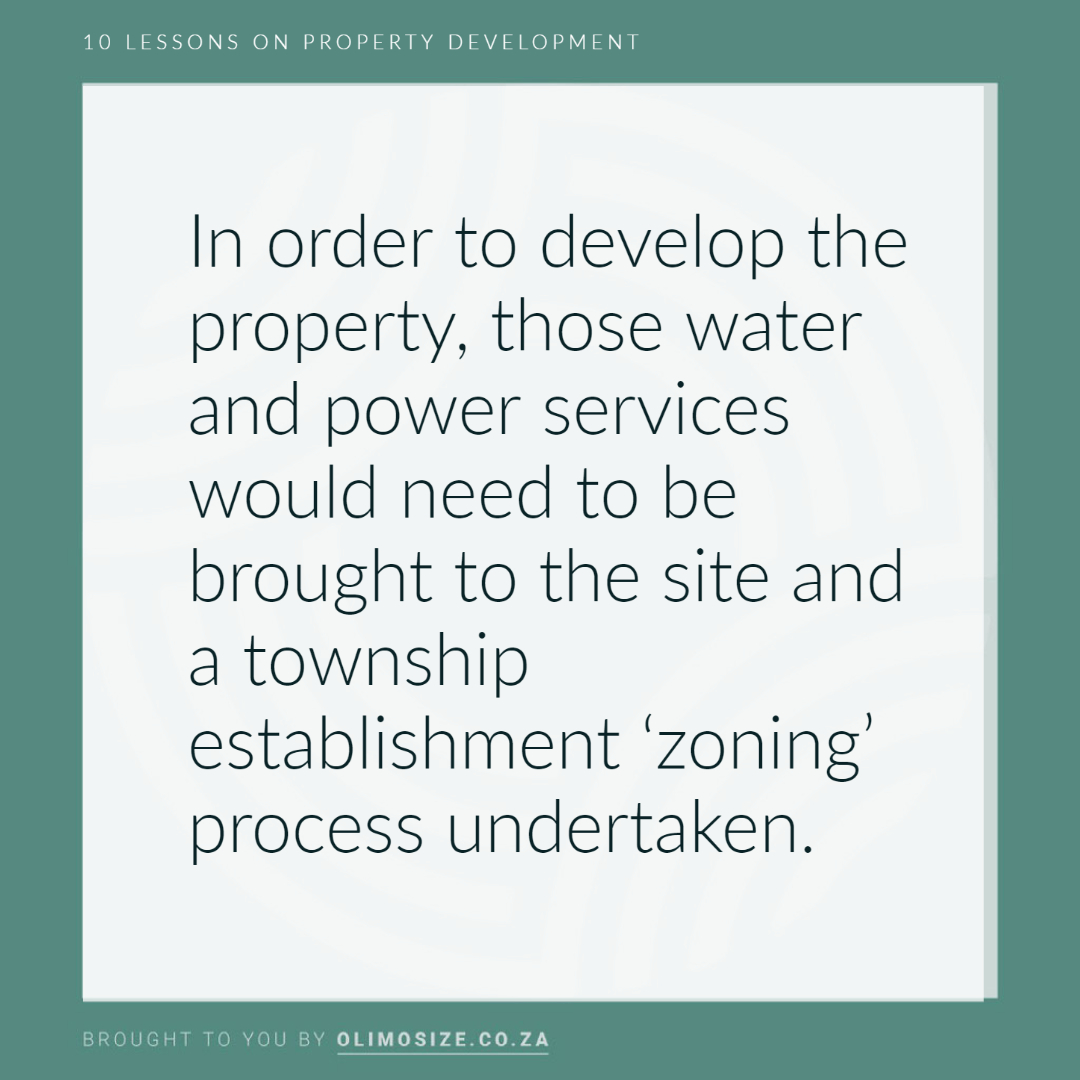
In development terms, this site would be classified as a "Greenfields" site. Which means it has never had any kind of development or building done on the property previously, but what does that mean for the developer? In a nutshell, it means that the developer as part of the complex development, would need to install all of the bulk services; that being potable water, sewer, power, stormwater and road infrastructure onto the site. Or in simpler terms, you have to pay for the connections to have water and electricity on your land. Plus, you would have to undertake a new township establishment application, this is an incredibly expensive and lengthy exercise involving a number of technical / engineering studies to be undertaken.

OlimoV3-3.1


For a project like this one, it is crucial to understand all of the development costs, before making a final decision on whether to proceed with the development. These costs would include a full professional team to establish the township, design and get approvals for the development. This application also includes town planning and building control fees, bulk services contributions payments and connection charges, as well as installing the bulk infrastructure. As I'm sure you know, if the numbers don't work, the project won't work, so with all these extra costs, be sure that what you get out in the end will still be worth it.


A thing I hear often from property entrepreneurs is that they only want to use other people's money to fund their developments, but this is only possible to a point. In order to do a proper due diligence on a property, to understand the feasibility and all of the development costs as discussed, a certain amount of upfront work and studies are required by professionals, such as a QS, planners and engineers, and this does not happen for free. An Investor is not going to be willing to fund the due diligence portion of the project, as there is no return them there, especially if the studies reveal that the project will not work on that site. As the developer, you need to have cash-flow / seed capital to fund the due diligence process.

OlimoV3-5.1


There you have it, part 3 of the 10 lessons I have learnt about developing property through being a project manager. I hope that you have gained some insight from this article that will help you to make more informed decisions on your next building project.


Be sure and keep an eye out for my next articles on the remaining lessons, and leave a comment with any questions or topics you would most like to hear about next. You can also sign up to our mailing list and receive our articles direct in your inbox so you never have to miss an issue.
Sign Up Here

10 Lessons – Part 2 – Zoning

10 Lessons - Part 2 - Property Zoning


Hi, and welcome back to part 2 in our 10 part article series on the 10 things I have learnt about property development, while navigating construction and property investing in South Africa.


Let's jump right in to our next topic, property zoning.


This short article is by no means a full explanation of property zoning, but is an overview of why understanding the zoning on a property is important for a property developer or investor.

Property Zoning is undertaken by a municipality to allocate specific types of land use within certain zones of development or activity. Think of how a town is laid out, with suburbs in one area and industrial works in another. Each property falls within a selected zone of development, and has regulations applied as is relevant to the zoning allowance.


As briefly stated above, each suburb or township, town or city and metropolitan area, has its own set of rules around land use and the types of development they will allow in certain areas, and Durban is different to Johannesburg, and both of them are different to Cape Town. It is best to check the Land use scheme for your area, if you are planning a big and bold development. .


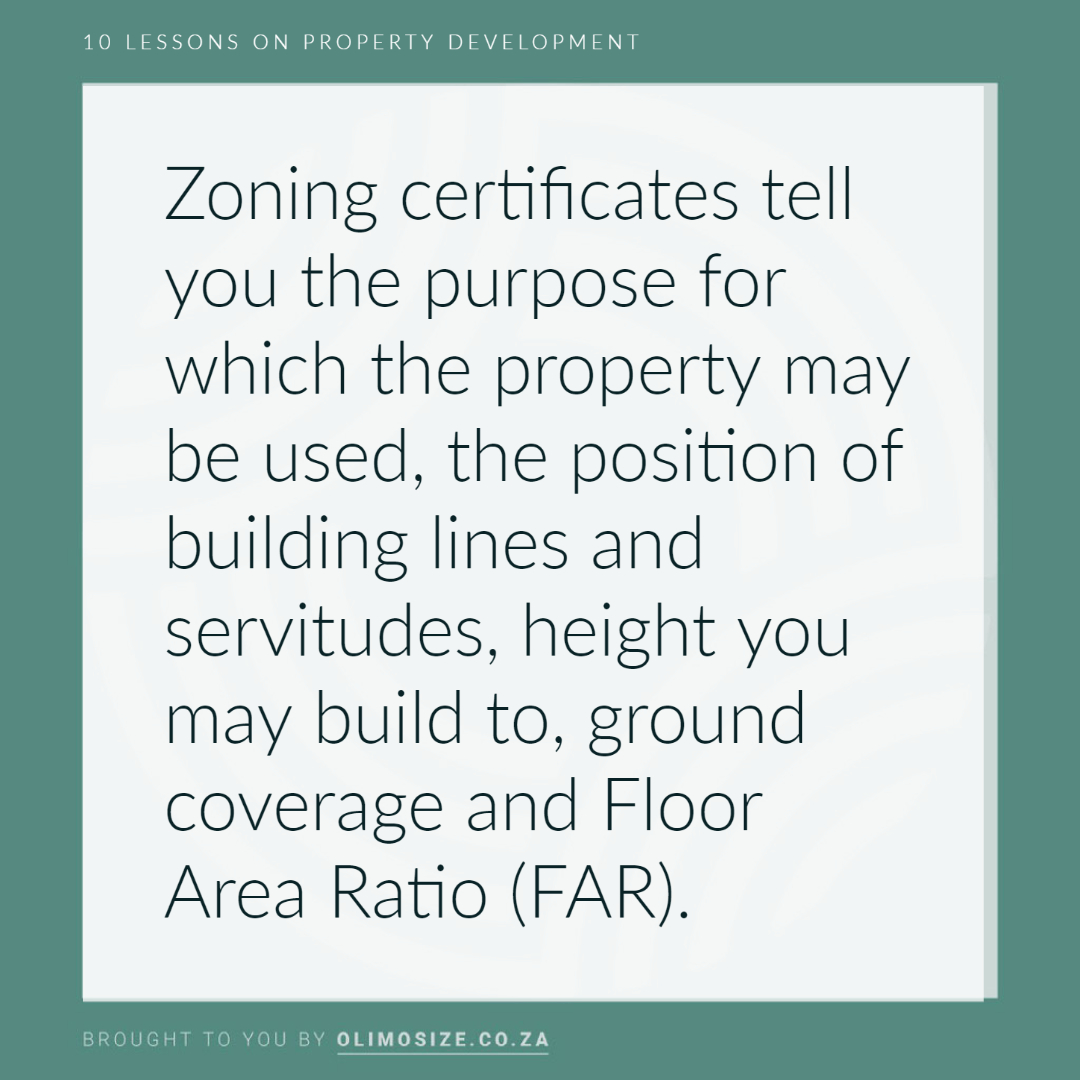
For our first lesson we spoke about paperwork being very important to your due diligence process and, that one of the pieces of paper to have is a zoning certificate. The municipality will issue a Zoning Certificate and SG Diagram for the property as per the respective development zone, they tell you the purpose for which the property may be used, the position of building lines and servitudes, height you may build to, ground coverage and Floor Area Ratio (FAR). These certificates will tell you about what the rights and development potential are for your specific property. So what does that mean. It means that you will know if you can build a double story block of townhouses, or a four story apartment block. You will know if you can legally have those extra units and still have enough parking and without building over the property boundaries or covering too much of the ground area.

OlimoV2-3


Let me give you an example.


If we consider a property not having approved building plans, and to answer a question of if the development would have been approved in terms of the land use scheme. The first department that gets to appraise plans is Town Planning. They will check the plans in terms of the current zoning on the property and what is allowed in terms of land use. To follow on with the example, for additional units on the property without plans, it is possible that the zoning would need to be adjusted on the property so as to allow for the increased occupation density planned for the property with the additional townhouse units. Should the property not have the correct zoning in place you would have to get a rezoning done, and that process extends your property development project by many, many months and increases the development costs through approval and professional fees to get the approvals passed.


This point is one of the biggest stumbling blocks for developers that I see on a regular basis. Not enough is generally known around all the intricacies of zoning approvals, or the requirements are known, but the property owner is reluctant to pay the additional costs and takes a chance.
OlimoV2-5


There you have it, part 2 of the 10 lessons I have learnt about developing property through being a project manager. I hope that you have gained some insight from this article that will help you to make more informed decisions on your next building project.


Be sure and keep an eye out for my next articles on the remaining lessons, and leave a comment with any questions or topics you would most like to hear about next. You can also sign up to our mailing list and receive our articles direct in your inbox so you never have to miss an issue.
Sign Up Here

10 Lessons – Part 1 – Paperwork

10 Lessons - Part 1 - Paperwork


Hi, I'm Marie and I'm a Construction Project Manager by profession, and in this 10 part article series, I will share with you the 10 things I have learnt about property development, while navigating the construction of buildings in the South African climate, and that have helped to make my property development journey easier, and hopefully yours too.


I've been involved in the construction industry for the last 10 years and a property investor for 4 years, but I still consider myself to be learning the ropes, as there are always things that can catch you out. So, if your building project or development is big or small, the principles set out here are similar for their execution.


Before we get started, in these articles we're not talking about how to invest in property or how to find a good deal. We're talking about the things that can, and all too often do, catch us out on a building or development project, and all the wonderful things that happen when you've all but signed on the Offer To Purchase dotted line, and you are itching to start building your dreams.


Let's get started!


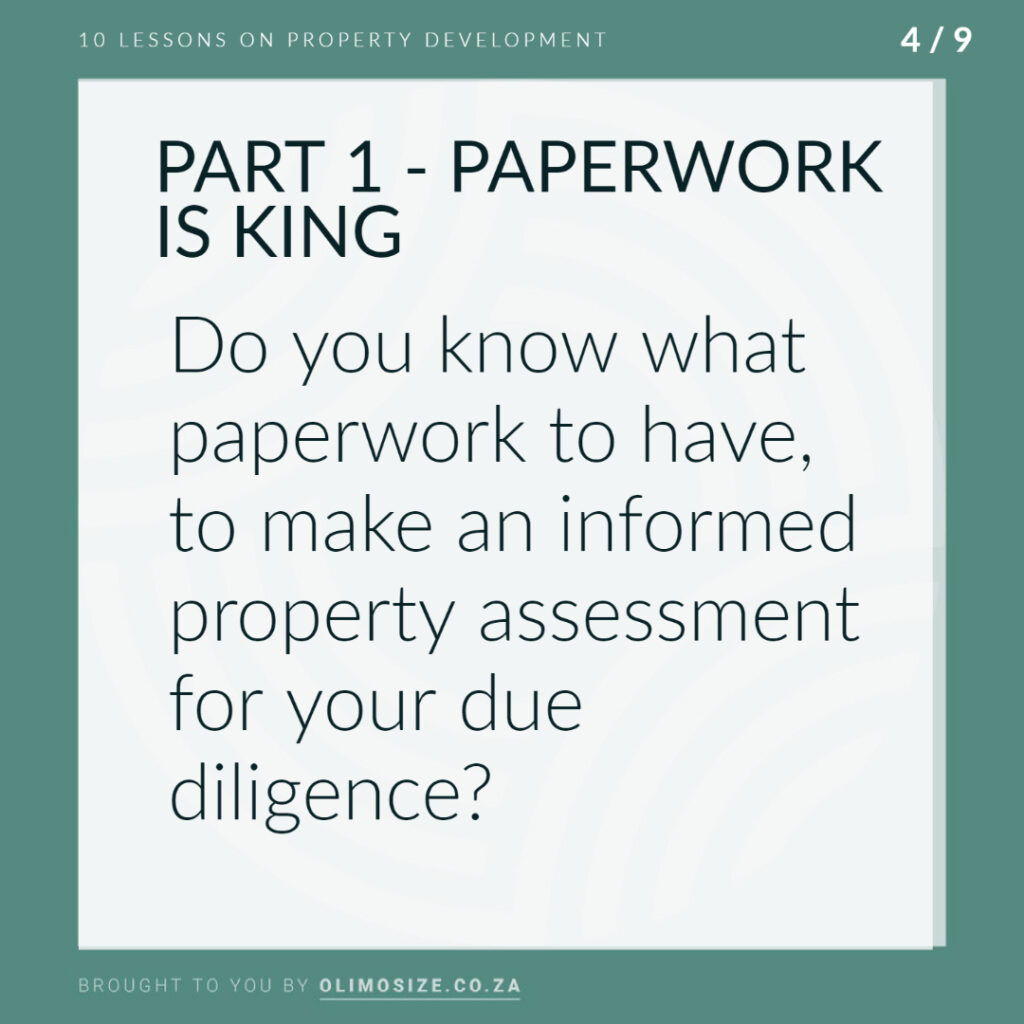
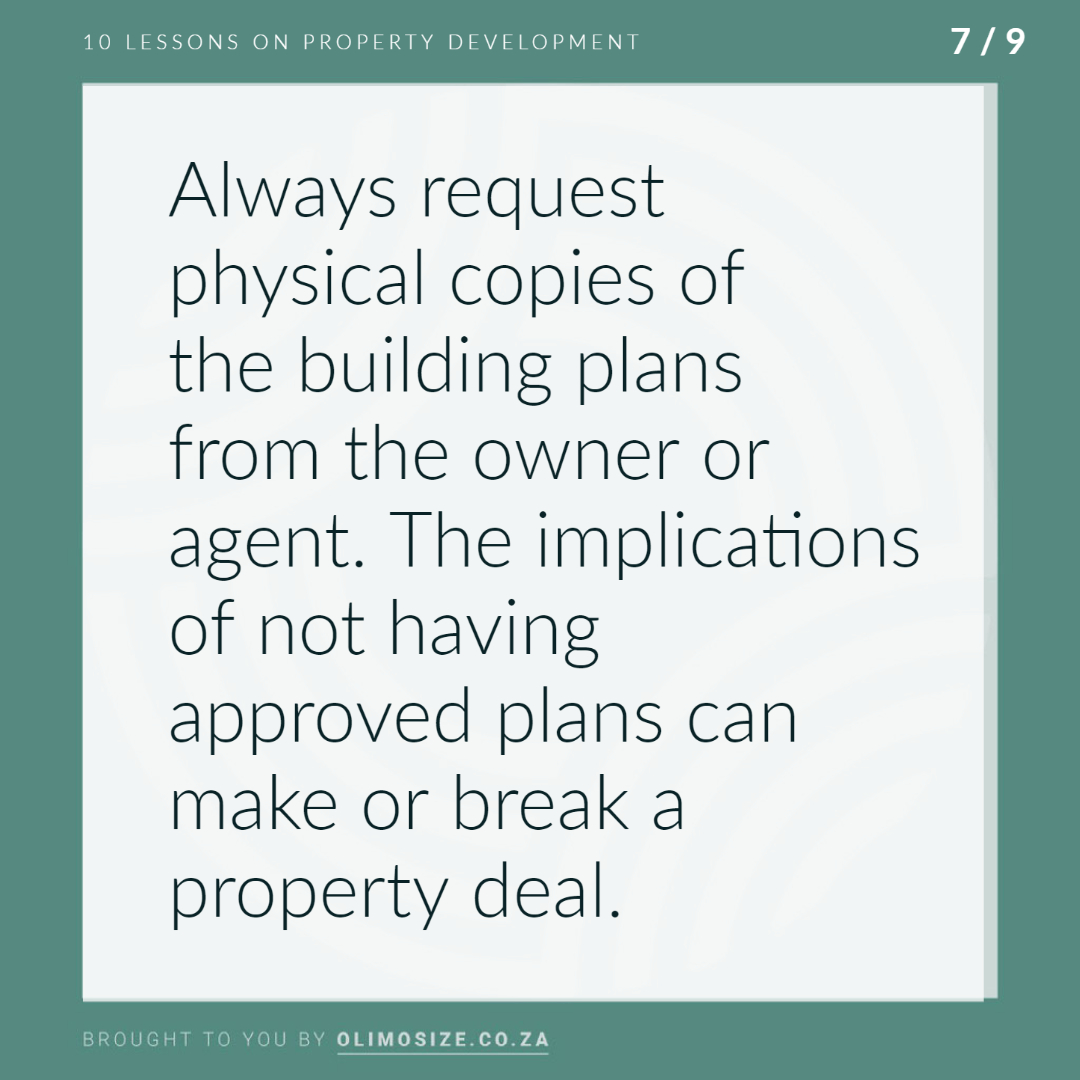
Part of any good property investment is doing your due diligence, and that entails finding out everything that you can about the property you want to buy. When you are looking to further develop the property by adding buildings or structures, you need to know what has been done there before, and what you are allowed to do now. Always ask for copies of the approved council building plans from the agent / owner. These plans will tell you if the buildings were correctly and legally built to begin with, and you will need them if you want to submit new building plans for any alterations you want to do.

OlimoV1-4


Another handy piece of paperwork to have is the Zoning certificate for the property. This certificate will tell you to what height you can build on the property, how much of the ground can be built on, the types of buildings allowed, the maximum size of the building that is allowed and any other restrictions that there may be on the property.


Let me give you an example.


The property you are interested in buying is in a prime location, a great plot of land with a 3 bed house, and some townhouse units on it, and space for a few more. You are banking on this being an investment that will be able to earn you income fast, its perfect. You've got the existing building plans and your dreams are alive. Emotions run high, it’s the best deal! You sign on the dotted line. No suspensive clauses, and you are locked in. You start to look at the development and are advised that the plan copies that you have are in fact not approved, and an entire set of building plans would need to be submitted for your new townhouse units and the ones that were already there! But the implications of this don't stop there, if there are no approved building plans, how do you know that the buildings were in fact built to any kind of regulatory or engineering check? That they are approved in terms of the city land use scheme? How do you know they are safe to live in? Implications of these items would require specialist studies to be done to check, and will cost a lot of money to resolve.


These two pieces of paperwork are probably the most essential in your pack, especially if you intend to make alterations to the buildings or further develop the property as part of your investment strategy.
OlimoV1-7


There you have it, part 1 of the 10 lessons I have learnt about developing property through being a project manager. I hope that you have gained some insight from this article that will help you to make more informed decisions on your next building project.


Be sure and keep an eye out for my next articles on the remaining lessons, and leave a comment with any questions or topics you would most like to hear about next. You can also sign up to our mailing list and receive our articles direct in your inbox so you never have to miss an issue.
Sign Up Here