10 Lessons – Part 10 – Maintenance

10 Lessons - Part 10 - Maintenance


Hi, and welcome to the final installment in our 10 part article series on the 10 things I have learnt about property development, while navigating construction and property investing in South Africa.


In this article I want to talk about looking after your investment once it is built. It's an unfortunate thing that maintenance is usually the last thing on a landlord's mind, but the significance of not taking care of your asset and the costs that can come from not doing regular maintenance, make it a point worth noting and acting on.


A property that has been invested in, should be maintained in order to uphold its value. There is nothing worse than driving past a property where the fence is unpainted, or half of the sign has fallen down, looking as if there is no care at all what the building looks like. Small things make a big impact, and when it comes time to rent or sell the property, it is those things that will make or break the asking price. Additionally, people don't want to live or work in a dilapidated building, so maintaining your property increases your likelihood of securing and keeping good quality tenants who will look after your property in the same way that you do.


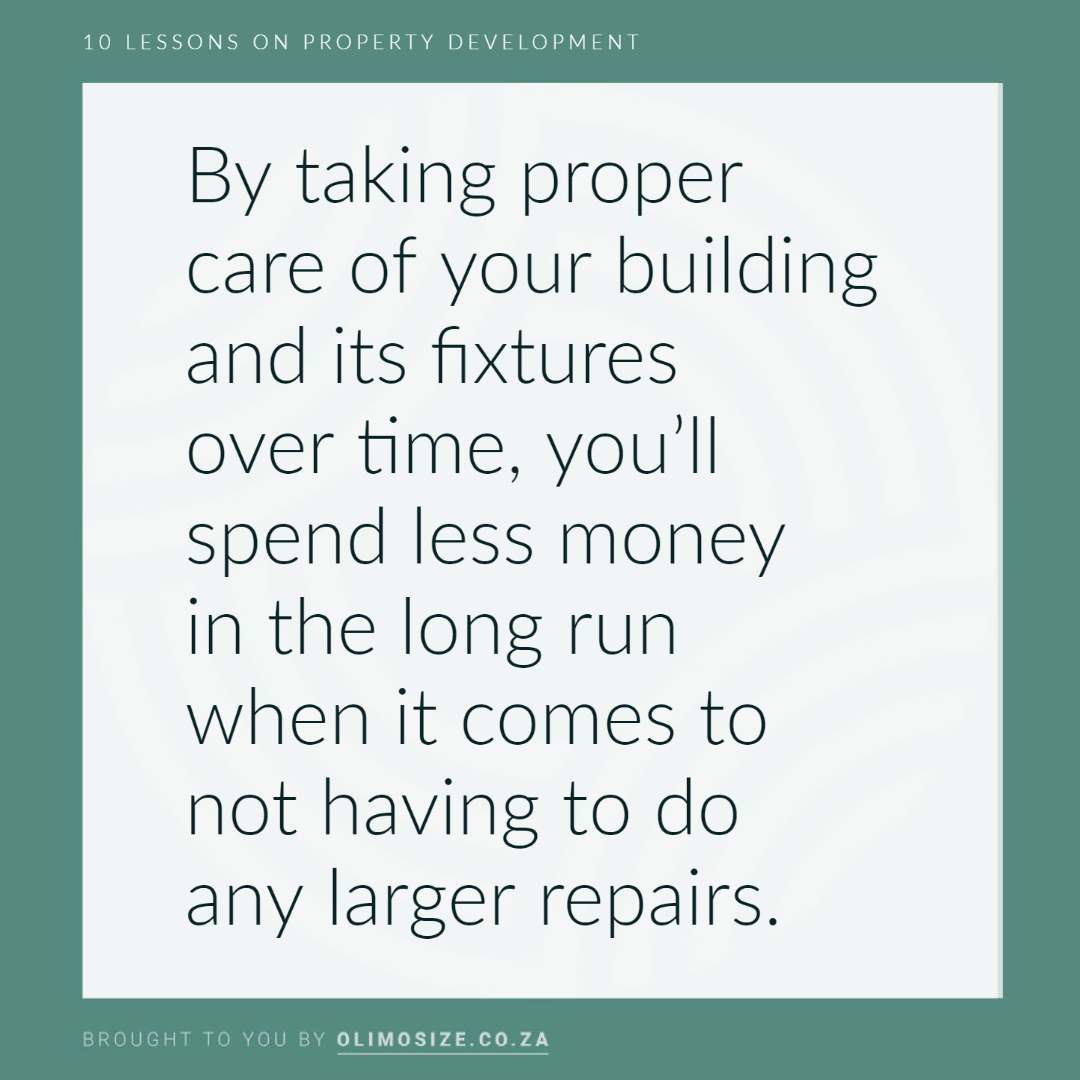
Maintenance is a bugbear to many landlords .However, it is prudent to remember that just as doing the regular services, and replacing worn parts is required on a car per the maintenance manual, so it is with a property. Globes have a certain lifespan, gutters get full of debris, fascia boards become loose, the walls need a fresh coat of paint. These are the items that help to build the equity on the property, and by taking proper care of the building and its fixtures over time, that you spend less money in the long run when it comes to not having to do any larger repairs.
OlimoV10-31


It will help to keep track of the maintenance needs for all of the properties with the help of a maintenance plan. This can be as simple as creating a list of items that need to be checked around each individual property, and an indication of how often these things should be done in a year. Then plotting them out in the calendar. For example, things like cleaning the gutters would be done once a year, or more often if there are many trees close to the building and outside lights should be visually checked every month. Create a system that takes care of itself, because then things are done in time and not because of necessity, which costs less money.


Just like you would hire a property management company to oversee the proper letting of your property, it is a good idea to have a team of handymen that you can call on should any minor repair works be required, and to assist with maintaining your property to the desired standard. This team would include a plumber, electrician and general handyman. Things will break at the worst and most inconvenient time, so having a team that you can call on for fast assistance is a real benefit.
OlimoV10-51


There you have it, the final installment of the 10 lessons I have learnt about developing property through being a project manager.

I hope that you have gained some insight from these articles that will help you to make more informed decisions on your next building project.


Be sure and keep an eye out for our upcoming articles with new and interesting topics on developing your property. As always leave a comment on our social media pages with any questions or topics you would most like to hear about next.

You can also sign up to our mailing list and receive our articles direct in your inbox so you never have to miss an issue.
Sign Up Here

10 Lessons – Part 9 – The builder

10 Lessons - Part 9 - The Builder


Hi, and welcome back to part 9 in our 10 part article series on the 10 things I have learnt about property development, while navigating construction and property investing in South Africa.


In this article I have some words of advice on the builder / contractor that you select to undertake your building works for you. Contractors generally have a certain level of building experience and checking their registered associations, CIDB grading and references, will give you an indication of this level of experience. Most importantly make sure to deal with a contractor who has the experience to build the type of structure that you intend to build.


It's been said over and over, don't use a builder who is not NHBRC registered. This is important because then there is a form of recourse should something go wrong. Unfortunately in the world there are a few unscrupulous people around who are willing to take advantage of others with lies and deceit. Don't just trust a builder that says trust me, rather know the truth for yourself.


Let me give you some examples.


Check and agree on your builders quote, what is included and what is not, and when he starts working check the products being used against the quote, or get a professional to check it for you. Get the builder to provide the full detail for the products being used. For example, make sure you know what type of paint he is using, and how much paint it should take to complete the work. You have a right to understand the quality of the products being used. Not to mention, he may be charging you for the most expensive paint, claiming to use more than he is, but buying and using the cheapest paint. Check the builder. In larger developments, specifications would have been provided by the architect and engineer and the specified items would need to be approved by the professional before they are used or installed.


Unfortunately it cannot be overlooked that some builders will claim to be established and have established teams, but often times, they will simply make up teams of men to complete works from casual laborers, and have a supervising foreman overseeing the work. These types of construction teams can become difficult to manage, as there may develop a dispute between the laborers and the builder, especially if he has not paid them, which would impact on the work, and become your problem to resolve.

OlimoV9-31


The JBCC (Joint Building Contracts Committee) suite of contracts offer contracts that can be used with your building project. I would recommend The JBCC® Small and Simple Works Contract for your project (smaller projects). This contract is intended for alterations, renovations and additions to existing buildings, or generally used for works such as new building works that are not more than three stories in height and where no sophisticated building systems are used nor complex services are to be installed.


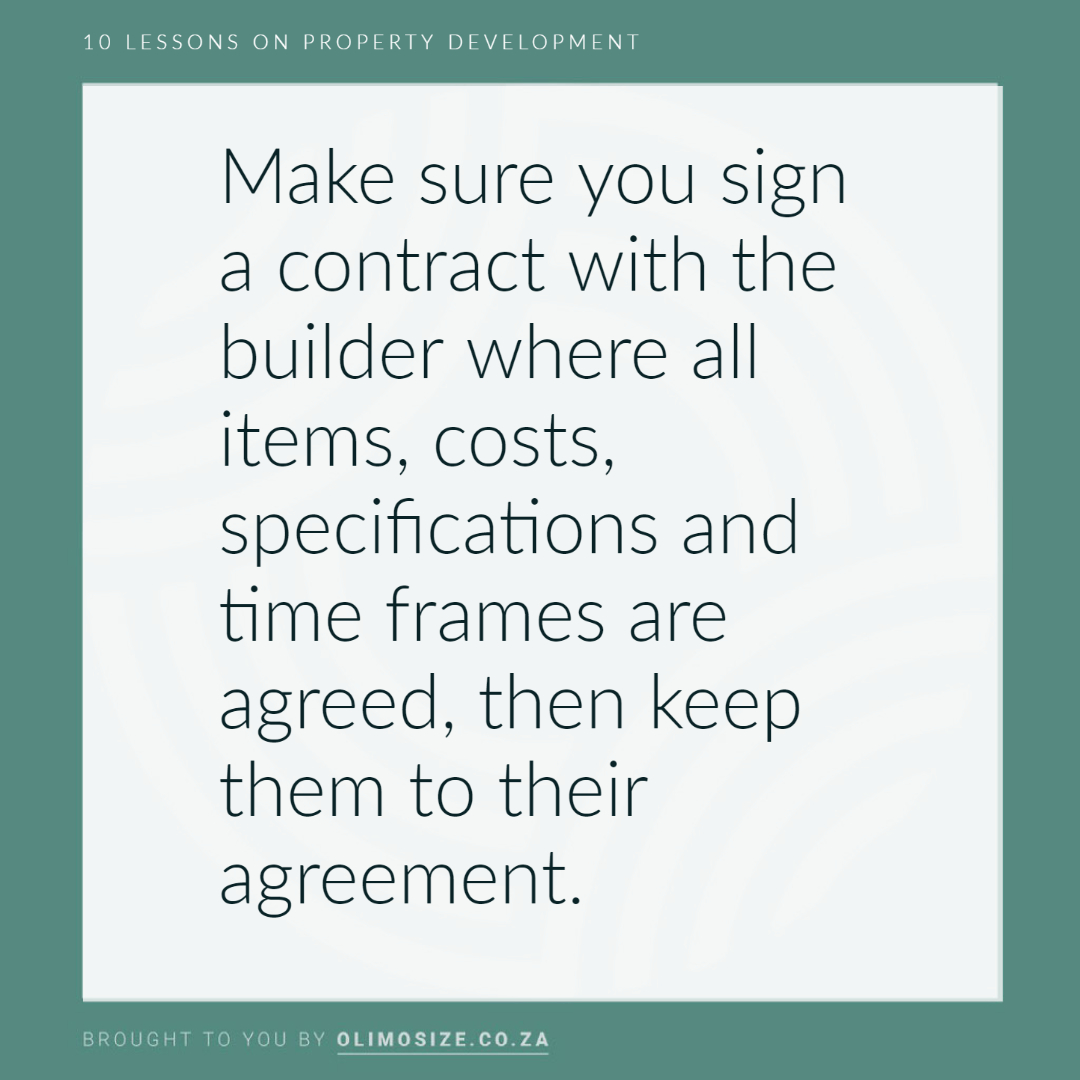
Make sure you sign a contract with the builder where all items, costs, specifications and times are agreed, then keep them to their agreement.

OlimoV9-61


There you have it, part 9 of the 10 lessons I have learnt about developing property through being a project manager. I hope that you have gained some insight from this article that will help you to make more informed decisions on your next building project.


Be sure and keep an eye out for my next articles on the remaining lessons, and leave a comment with any questions or topics you would most like to hear about next. You can also sign up to our mailing list and receive our articles direct in your inbox so you never have to miss an issue.
Sign Up Here

10 Lessons – Part 8 – Costs

10 Lessons - Part 8 - Costs


Hi, and welcome back to part 8 in our 10 part article series on the 10 things I have learnt about property development, while navigating construction and property investing in South Africa.


At some point in most of the articles so far the point of additional costs has come up, and those would have given you an idea of some the items that can increase your project's development cost. In this article I am going to expand on this point a bit further, because as investors there are some things you can look out for, for yourself which can help to keep these 'surprise' costs to a minimum.


Having done a desktop due diligence would have provided a reasonable estimate of the anticipated costs for the project. Most property investing courses will teach you to include for all the bond, attorney and transfer fees, to account for holding and vacancy costs, and the renovation costs as provided by your builder friend. However, in many cases with simple desktop or estimated assessments there are costs that can be missed, over or underestimated. This is why it is important to put a suspensive condition into the offer to allow for time to do a proper due diligence, so that the correct cost can be determined. Additional fees from professionals service providers, town planning approval costs, and decorative finishing items can bring a large price tag.


Let me give you an example.


The property to be redeveloped has an existing building which needs to be demolished, but there are no other items that appear to need special attention. The external wall looks in good condition and there are some large trees in the yard. An architect friend drew some plans that will go to council for approval. The contractor has given a quotation which includes the demolition of the existing building and building the new house. All of these costs are allowed in your deal calculator and the deal is looking very good.


Starting with the due diligence process, shows that apart from the building plan approval process, there are other approvals also required for the demolition of the existing building, and to obtain a wayleave for the pavement and driveway indicated on the building plans. Obtaining these approvals requires drawing submissions by professionals, therefore additional costs are incurred through professional fees and council submission fees. There are also instances where further reports are required to support an application, which increases the professional fees even further.

OlimoV8-31


The large trees in the yard are another point to note. If the new building requires that the trees be completely removed, as they will interfere with the placement of the building foundations, then it is important to realize that tree removal is an expensive cost, as large trees require the entire root stump to be removed which can run deep into the ground, and are heavy to move.


Contractors often leave things out of their quotes, or will provide a provisional sum value, especially on items that need to be manufactured and installed by specialists. These would be things like the type of tiles, air conditioning systems, solar or generator power systems, landscaping, etc. Extra items like this can start to add up in cost very quickly.


A list of additional costs like this can make or break a project, so know what is coming to build a better deal, and then stick to the budget. If everything is agreed upfront in terms of costs and specifications, then apart from annual escalation, there should be no reason for costs to move.

OlimoV8-61


There you have it, part 8 of the 10 lessons I have learnt about developing property through being a project manager. I hope that you have gained some insight from this article that will help you to make more informed decisions on your next building project.


Be sure and keep an eye out for my next articles on the remaining lessons, and leave a comment with any questions or topics you would most like to hear about next. You can also sign up to our mailing list and receive our articles direct in your inbox so you never have to miss an issue.
Sign Up Here

10 Lessons – Part 4 – Project Teams

10 Lessons - Part 4 - Project Teams


Hi, and welcome back to part 4 in our 10 part article series on the 10 things I have learnt about property development, while navigating construction and property investing in South Africa.


Let's jump right in to our next topic, Project teams.


In this weeks' article we will be talking about the team of professionals that are required to allow a property development project to get out of the ground. Having your power team together when putting together a property deal is a hot topic in investor circles, but the team usually spoken about, only focus on the legality and financial aspects of the deal itself. Once you are ready to move ahead with your project, there is another team that is required in order to make the rest of a development project work properly. Most of the team members mentioned below are required from the due diligence stage of your project and I'm going to give a breakdown of some of the professionals who will form a crucial part of that team:


A Project Manager


(that's us) We're the people who are going to help to navigate the murky waters of bringing the development into reality. Developing a property can be a time-consuming and technically detailed process, so having assistance from a professional who has the right knowledge and understanding and can assist in effectively managing the project, to bring it legally, timeously and within budget to completion, is crucial. It would be my function to ensure that the correct professional team is in place and performing their functions; that the building plans are submitted, approved and used correctly; that the appointed contractor is working to code and within budget; and to ensure that at the end of the process a legally built development is handed over for occupation. To note just some of the issues that are managed by the project manager..


TIP: Use a Project Manager who has experience with the types of developments that you are trying to undertake.
OlimoV4-31


They will assist you in understanding the land use rights and current zoning information for the property in question. Remember, I mentioned them in my previous article on zoning. They also assist with preparing and submitting any applications that may be required in terms of land use. If any other studies are required that relate to the land-use, these services will usually be included under this professional, but may be undertaken by other professionals. Such studies could for example be, environmental impact assessments, geotechnical investigations and land surveying, to mention only a few.


Town Planner


Architect


TIP: Select a Town Planner who operates within the area of your development, as they have intimate knowledge of the scheme for the area.


I'm sure all of you know this one. The architect will help you to design the building structures and site layout for your development. What I mean by this tip, is that different types of buildings require different components in the design. Commercial and residential buildings are different in how they work, and this is reflected in the design drawings. Some architects will also only provide a concept design, that would be passed by council, however, they do not provide any further design input, such as construction layouts, tiling layouts, door and window schedules or product specifications to achieve the look proposed. To source all of the different products yourself takes up a lot of time and energy.


Quantity Surveyor


TIP: Make sure you appoint a professionally registered architect and one with experience with your type of development.


A quantity surveyor is the person on your team that determines exactly how much your building work is going to cost. They understand building methodology and therefore understand the different activities and products that need to be used to build, for example, for building a foundation, they will understand that you need cement, sand, stone, bricks, shuttering and rebar, etc., and they understand how to calculate the quantity that is required for the work. The quantity surveyor is better to use than a builder when costing a project as they are independent and are able to provide objective, market related pricing, where a builder / contractor may often take the highest priced option or omit items, which could impact the project budget later on.


TIP: It is better to use a quantity surveyor to measure and cost your project than a builder.
OlimoV4-41


There you have it, part 4 of the 10 lessons I have learnt about developing property through being a project manager. I hope that you have gained some insight from this article that will help you to make more informed decisions on your next building project.


Be sure and keep an eye out for my next articles on the remaining lessons, and leave a comment with any questions or topics you would most like to hear about next. You can also sign up to our mailing list and receive our articles direct in your inbox so you never have to miss an issue.
Sign Up Here

10 Lessons – Part 3 – Vacant Land

10 Lessons - Part 3 - Vacant Land


Hi, and welcome back to part 3 in our 10 part article series on the 10 things I have learnt about property development, while navigating construction and property investing in South Africa.


Let's jump right in to our next topic, Vacant Land.


In this weeks' article we will be talking about buying a farm or piece of vacant land, and all of the things you need to get done before your building dreams can take flight.


Let me give you an example.


Here's the scenario, you have found a great piece of land just outside of town in a mostly agricultural area which has recently started sprouting large sectional title complexes. You want part of the action to build your own townhouse complex and so you buy the land.


In development terms, this site would be classified as a "Greenfields" site. Which means it has never had any kind of development or building done on the property previously, but what does that mean for the developer? In a nutshell, it means that the developer as part of the complex development, would need to install all of the bulk services; that being potable water, sewer, power, stormwater and road infrastructure onto the site. Or in simpler terms, you have to pay for the connections to have water and electricity on your land. Plus, you would have to undertake a new township establishment application, this is an incredibly expensive and lengthy exercise involving a number of technical / engineering studies to be undertaken.

OlimoV3-3.1


For a project like this one, it is crucial to understand all of the development costs, before making a final decision on whether to proceed with the development. These costs would include a full professional team to establish the township, design and get approvals for the development. This application also includes town planning and building control fees, bulk services contributions payments and connection charges, as well as installing the bulk infrastructure. As I'm sure you know, if the numbers don't work, the project won't work, so with all these extra costs, be sure that what you get out in the end will still be worth it.


A thing I hear often from property entrepreneurs is that they only want to use other people's money to fund their developments, but this is only possible to a point. In order to do a proper due diligence on a property, to understand the feasibility and all of the development costs as discussed, a certain amount of upfront work and studies are required by professionals, such as a QS, planners and engineers, and this does not happen for free. An Investor is not going to be willing to fund the due diligence portion of the project, as there is no return them there, especially if the studies reveal that the project will not work on that site. As the developer, you need to have cash-flow / seed capital to fund the due diligence process.

OlimoV3-5.1


There you have it, part 3 of the 10 lessons I have learnt about developing property through being a project manager. I hope that you have gained some insight from this article that will help you to make more informed decisions on your next building project.


Be sure and keep an eye out for my next articles on the remaining lessons, and leave a comment with any questions or topics you would most like to hear about next. You can also sign up to our mailing list and receive our articles direct in your inbox so you never have to miss an issue.
Sign Up Here